It’s 3 A.M. Why am I awake?

I notice the quiet darkness of early morning.  A bit of muffled traffic noise filters through my open window as I wonder if it’s better to get out of bed and really wake up or stay in one spot and hope to fall asleep again within seconds.

Depending on my schedule in the morning, waking up at 3 a.m. can be unnerving. A good night’s sleep for me is as restorative as all the hype says it is. Some nights, however, I wake up far too early. The mental argument of whether sleep will reoccur within moments or get up and do something since I am awake anyway keeps me…awake.

The resolution? Get up. Go to my writing room and curl up in my easy chair. Get out paper, pencil or turn on the computer and write.

Whether it is the muse, the moon, the subconscious or the quiet, working in combination or individually to stimulate the flow of ideas and details to create words, blog entries or stories, I don’t know. I like to believe it is all that and something more that doesn’t have a name.

The smartest thing I can do when I can’t get back to sleep is head to my writing space. Answer the call. Trust that there is a reason, one deeper that I can understand, at work here to get me to the words.

The practice is full proof. I am never disappointed in what I create between 3 and 5 in the morning.

Before I began this entry, I generated a list of 26 topic possibilities for this blog. It’s rich fodder for future compositions. Best of all, I started my day with my own writing, even if I head back to sleep for a couple more hours.

Learning in the Dark

(Originally hand-written on July 1)

I notice how I grope in the dark, flipping on and off light switches in spite of the fact that my electricity’s been down for over two days.

I need to know about sea anemones. At this very minute. A scene in my fantasy novel calls for my mermaid to swim among such sea plants while a storm is about to blow.

How do anemones react in churning water? Do they wave their jelly-like arms or do they close into themselves until seas become calm? Is a “bed” of anemones the appropriate term to describe them?

My personal library has quite a few books on sea life. I’ve scanned some, read some, post-noted many pages, written out facts on index cards and in notebooks.

But it is oh-so-easy to click an Internet search engine and type in “sea anemones” and look at the results. It’s always right at my fingertips.

But now I am in the dark.

I depleted my laptop battery juices last night. During daylight, I edit my novel using pencil and a paper copy of the book I had run off a few weeks ago when I gave three copies out to readers for the final critique.

Good, old-fashioned planning and foreshadowing.

Computer technology and all its accompaniments display the genius of the twenty-first century. Nevertheless, to keep all that technology humming, I continue to require the creative invention of the 1800s by Thomas Alva Edison–electricity.

And thank goodness for something even older than Edison–fire.

Lately, lighting candles has taken on more dimensions than romance and ambience.


Daydream, Fantasy, Alligator, Mermaid

I notice a white cement alligator in a wood chip garden path in midwest Ohio.

I confess. The alligator is in my backyard. I didn’t buy it, but I didn’t talk the buyer out of purchasing it either. So there it lurks between the black-eyed susans and the honeysuckle, scaring no one. But it serves a purpose. It represents someone’s fantasy or daydream.

Not mine. But I can relate.

You know when you daydream while listening to a lecture? or staring out the window of a car? or after reading a good passage from a book? They are fantasies.

When I was a kid, I daydreamed about being a horse or an eagle like a lot of children. As I grew up, the horse and eagle fantasies passed on but not the mermaid. She aged with me from young adult to adult. She didn’t occur too often, but when she did, it was usually before falling asleep.

My first desire in producing fiction was to capture my mermaid daydream. I honed my writing skills by creating a variety of short stories. After eight months, I was ready to pen my fantasy.

The story took maybe three hundred words on less than two pages. That was it. The fantasy, which had been with me for almost my whole lifetime, contained one scene: a mermaid swimming to shore and a man finding her.

Three years later, the narration fills more than 200 pages and over 60,000 words.

That’s quite a daydream for a writer from Ohio about a mermaid from the Caribbean.

On Grandma’s Kitchen Table

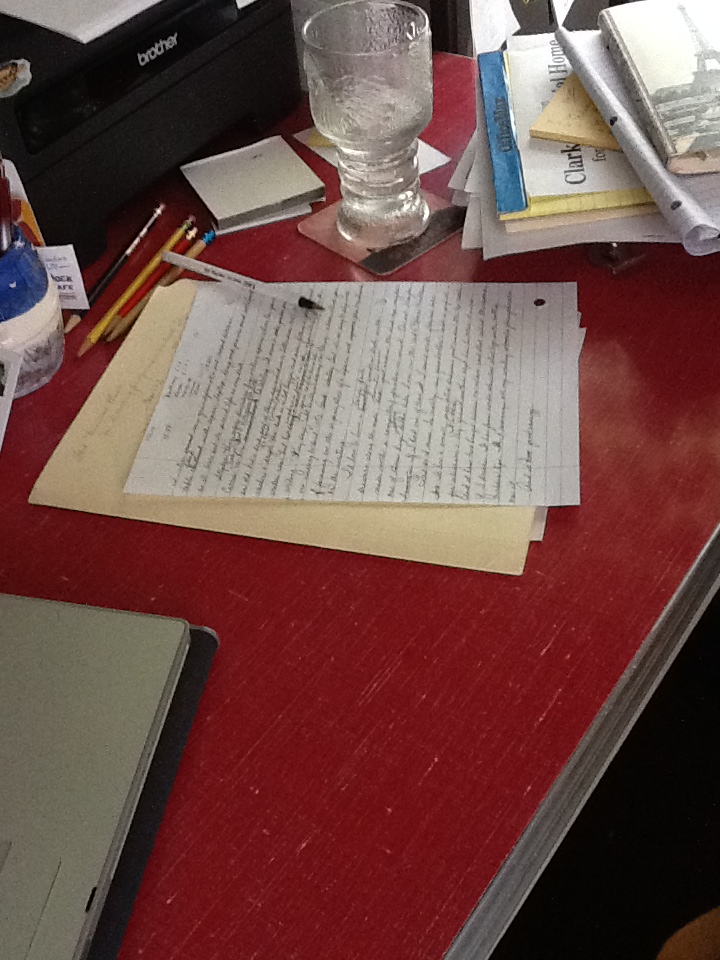
I notice my grandparents’ 1930s red-topped kitchen table. The top of it is somewhat organized with a copier, laptop, lamp, pencils and notebooks as it lives its second life as my desk in my writing room.

Stephen King describes his writing space where he penned his first books Carrie and Salem’s Lot in his Memoir on the Craft: On Writing. It wasn’t pretty–an old kid’s desk sort of thing squashed in an area next to the washer and dryer of a double-wide trailer.

Today, his desk is a lot bigger and more fitting a professional writer, but his point on writing surfaces isn’t on the furniture; it’s on the writing.

King says, “The space can be humble…, it really needs only one thing: a door which you are willing to shut.”

But it’s so easy to slip into focusing on the organization of a writing space and procrastinate on the writing.

I’ve imagined my DESK. It’s wide-topped, cherry wood, drawers down one side, narrow drawer just under the topside, maybe a shelving attachment for laptop and printer. Or not. Maybe it’s the old-fashioned, just mahogany and drawers type like the guys on the TV show Mad Men use in their offices.

Oh, the glorious tales I could create if I had one of those.

In reality, my grandparents’ table has a small, segmented drawer in the front made for silverware. It’s where my grandmother stored her butcher knives. It has two hinged leaves on either side to extend the surface space as desired. Thick stainless steel legs with rotting rubber tips hold it up.

My grandmother was the best cook and kindest soul. I’d see her every Sunday along with fifteen or more other relatives. We’d eat oven-baked, breaded chicken and chicken soup. In the evening, before we’d all head home, we’d make ice cream sodas. All homemade. All delicious. All eaten at the red kitchen table.

To date, I’ve written this blog, several short stories, two biographies, a fantasy novel and more using her table.

My desk isn’t going anywhere. It’s energy is too good.

The Antsy-ness of Lazy

I notice the hot embers of the last log burning out in the fire pit. Like a reptile, its skin of cornered segments pulsates degrees of redness in between the cracks.

I took the day off from writing. My immediate deadlines were met. Why not celebrate with guilt-free laziness? I sat on the back porch, water fountain bubbling nearby, huge old maple tree shading my head. I alternated between reading a fantasy about shape shifters of the animal variety and staring through the weaving of branches and leaves above me. I’d finally Imagefinish this book in a few hours.

But I was antsy. I moved over to the sunnier porch. I watered flowers. Even tried a nap. Then back to the book until it was done.

Near dark the fire was fresh and full of blue yellow flames of burning sticks and tree trimmings. I roasted a few marshmallows and sat staring in the night, fireflies rising from the ground, muffled traffic sounds in the distance.

The last flicker of blue died. The lazy day was finally done.

I curl up in my easy chair in my writing room, reading a Writer’s Digest magazine and taking notes before I fall asleep.

Of Birds and Book Business

I notice warm, moist air blowing in through the window at my back.

The breeze is not hot enough to kick on the air conditioning unit. I listen to the birds and their variety of staccato chirping a while longer.

I identify a few bird songs but not many. The amount of study needed to recognize more is intensive.

Navigating the publishing business is as intensive and its rules as unique as bird calls. It’s unlike many fields where showing up and doing the work begins the familiarity.  In professional writing, I sit here, at my desk, and hope that someone out there will take on my work and make it public. My familiarity comes from attending workshops, making connections and reading books and websites. And even then I am sure I have so much more to learn.

A baby grackle squawks for food or mother or both.

Artificially cooled air flows over the room from a ceiling register. I slam shut the window.

The only sound is the clacking of my computer keys.

“Today is My Moment. Now is My Story.”

I can’t be contented with yesterday’s glories.

I can’t live on promises, winter to spring.

Today is my moment. Now is my story.

I’ll laugh and I’ll cry and I’ll sing.


The weather has been unusually warm for January in Ohio, but today may be the last one full of sunshine and snowless ground. I put my laptop into sleep mode and drive out to a small lake and sit on a picnic table. A slight breeze ripples the water. I scrunch my hat over my ears and draw up my legs. A winter 50 degrees is still cold.

I count 167 Canada goose floating just offshore. Three doze, necks turned backward, beaks nestled into feathers.  All are quiet until two others fly in and land. But after a few honks, they bob in silence. I’m sure their kind have been bobbing on cold winter lakes for centuries.

It’s what they know how to do.

I slip my legal pad under my thigh. It’s blank.

I’m at a difficult place in my search for a literary agent. Time is running out on the one who held the most promise. I’ve got to start all over. Back to rewriting a query letter, reexamining the synopsis, maybe editing my novel’s opening.

Getting published is not what I know how to do. At least not with expertise. My “yesterday’s glories” were teaching high school English. Give me a text and a blank screen and I’d have an effective lesson plan drawn up in no time.

In my head, I hear John Denver singing a song called “Today.”

I pull out my paper and scribble down a few ideas.

“Now is my story.”

I love writing. In time and with experience, I’m sure I’ll be an old hand with the professional end of it as well.

Another pair of geese honk as they fly in and settle with the group. Four others honk back in return. The bobbing continues.


Image


Closure: John Updike and Sex

My first reading moment featuring a love story was the attraction between Tom Sawyer and Becky Thatcher in Mark Twain’s The Adventures of Tom Sawyer when I was in third or fourth grade. I can still conjure up their quick kiss in the cave scene in all its imaginative detail. Later, in early high school, I devoted myself to Jane Eyre’s search for purpose and discovering love with the dark, sophisticated and tormented Edward Rochester.

Amid the times when these classics encompassed my world of romance, the talk of sordid lust was through the popular Hugh Hefner’s Playboy and Penthouse magazines. No, I wasn’t a reader nor a peruser of the photos, but I had high school and college friends who were.

So it was one extreme or the other: the black and white movie type of suggested sex of the curtain blowing through the open window or the glaring centerfold and full color exposure. It was all make believe.

As a university English major, I took a class featuring novels by Philip Roth, Saul Bellow and John Updike. It was the first time I read work so realistic of adult modern day life. Characters were regular people who could be my neighbors or professors. No one was literally lost in a cave or had an insane wife locked on the third floor of his mansion. The stories featured male characters and, in my memory, all of the men in John Updike’s works were in search of sex. Sex in average bedrooms like the one in my house or, now that I think about it, anywhere they could get it.

While the professor expounded on the works’ lofty themes and literary genius, and I took notes as the dutiful student who knew an analytical paper was in the offing, my real thinking was somewhere else: focused on the overabundance of sex, real, suburban sex. And perhaps I pined for the want of a gothic structure or a one-of-the-boys relationships like Nancy Drew. Instead, I think I grew up during that course and faced an all-too-realistic literary adulthood.

Today, a few decades later, I finished reading John Updike’s collection of short stories entitled My Father’s Tears, first since 2000, the inner book jacket states. Males dominate each tale, but the men are older, much older. Some are in the suburbs, some are in foreign places. All are coping with aging. “The Walk with Elizanne” is about a high school reunion, same with “The Road Home.” Even those that feature boyhood like “The Guardians” and “The Laughter of the Gods” is from a senior male hindsight.

The one short with the greatest departure from my imposed Updike theme is “Varieties of Religious Experience.” It has sex, but love and faith from its domestic to its fanatical as it encompasses the terror of the Twin Towers on September 11, 2001, as experienced from various perspectives.

I gave away the John Updike books I had to read in college. I was through with the white guys in search of sex. Maybe too real for me. Maybe not. I reluctantly returned to his writing with his My Father’s Tears collection. And there I was, struck again with the same issues and felt the same realness. But this time the cold, hard facts of love were taken over by an aging, male mind who wondered whether love had met expectations, matched memories or redefined definitions.

John Updike doesn’t kid around with age. He isn’t imagining the stud muffins of his youthful pieces. They exist no longer because he exists no longer in that image.

His last two stories are my favorites: “Outage” and “The Full Glass.” I see them as his eulogy to himself. In “Outage” his older-now male, sex-driven ego sees itself in both states of fantasy and reality. “The Full Glass” is his swan song. Through all of John Updike’s personal journey as a youth, adult, author, lover, father, here he is, on the edge of living, looking back and seeing life as a full glass not an empty one.

I’m not sure whether I will read his work again. I like to consider the reason being that I have come full circle and see this collection as closure for a writer who introduced me to modern, everyday male characters and their quests for love that remain, like it or not, a part of my literary memory.

As such, I raise my full glass and offer a toast. Here’s to you, John Updike: Born in 1932. Died in January 2009.

Is There Ever an End to Writing Workshop Preparation?

I feel like I’ve read it all: how to behave at writing conferences, how to prepare the perfect sale’s pitch, what to say, what not to say.

Got my business cards with blog address on back. Getting my blog updated as I write. Have read the manuscripts of my writing intensive colleagues, submitted my twenty-page manuscript excerpt for review by a professional. Have the cash, checkbook, credit card to purchase books by visiting authors for signatures.

Am I ready?

I’d love to say yes, but the blotches on my face tell a different story. It’s like pimples popping out on a teenager’s face the morning of school photo day.

Stress.

I am off to the Antioch Writers’ Workshop in Yellow Springs, Ohio, on Saturday, July 9. I have bought into the whole program: Saturday seminar all day, full morning sessions all week, afternoon fiction intensive all week, two professional critique sessions about my manuscript excerpt, open-to-the public writer forums and readings every evening. I hope to sign up to pitch my novel (said manuscript) Mermaid with an agent. All that and making connections and picking up tips from other attendees and facilitators.

Conferences were easier when I was a beginning writer with nary a story to my name, just aspirations. Now I am in the group that has that “lean and hungry look,” not to assassinate Caesar but to bring attention to my work. It’s great because I passed that critical dateline from wannabe-writer-but-I haven’t-written anything to a writer-with -a- completed-novel-looking-for-an-agent-and-a-contract.  It’s scary because now there is evidence for someone to tell me how good, mediocre or poor I am.

Nevertheless, I am ready.

Wait. Not yet.

I need another container of make up to cover up these red blotches.

“Crystal Love” Takes Third in Short Fiction Contest

At six, Jade knew that the best things were over her head. Candy in the top cupboard. Cookies on the refrigerator. Tiniest toys on her closet shelf.  Prettiest statues above the fireplace.

When she saw Grandpa’s step stool next to the armoire in his room, she had to have a climb.

“Be careful, “ said Grandpa. “And hand me that old light bulb.” He tossed it in the trash then sat on the bed, breathing heavily.

“Aw, Grandpa. You gotta dust up here,” Jade said. She sneezed a few times to show she was serious but giggled when she lifted an old framed snapshot of him and Grandma making angels in the snow.

“I make snow angels too,” she said. “Is that you and Grandma? She’s just a girl.”

“She’s the best girl in the world, honey.” Grandpa stared at the tremor in his hands. “I would have given your Grandma the world if she’d let me. But we weren’t rich and never traveled far. Still, we’ve laughed a lot and enjoyed our times together.”

Grandpa pushed himself back toward his pillows and leaned against the headboard.

“We loved to take long walks together, especially in winter. Grandma always wished she could hold winter forever in her hands. To her it was the most romantic time of the year.”

He shut his eyes and folded his hands across his stomach, waiting for his breathing to even out.

Jade put the photograph aside and reached for something else. It was larger than her little fists. And heavy. She knew she would drop it if she tried to carry it in her hands.

She got her fingers around its base and slid it to the armoire’s edge. It was a glass ball but so grimy she couldn’t see anything. She tilted it over and cradled it in her neck.

“Grandpa?”

“Jade!” Grandpa hadn’t moved so fast in ages. He was off the bed and grabbing the globe from her. “My god, child, you could have seriously hurt yourself. Now get down off of there. Go see what Grandma’s doing in the kitchen.”

Grandpa sat back on the bed and held the globe in the palms of his rough, steel mill factory hands.

“Grandpa, what is it?”

Balancing the globe on his lap, Grandpa reached into his pants pocket and pulled out a washed-out blue bandana. Like he was bathing a newborn baby, Grandpa cleaned the globe of its dusty film.

Jade waited.

“Grandpa?” she whispered.

“Honey,” Grandpa lifted it up. “This is a snow globe. Grandma has loved this globe more than anything. She brought it with her when we moved in here after our wedding. She said her father gave it to her. She keeps it up on that armoire. Once in a while, I see her pick it up and shake it. She gets a little misty-eyed then puts it back.”

“See?” Grandpa turned it upside down and right side up again.

Jade leaned close and watched snow crystals sparkle as they settled over a bare tree and a bench. On the snowy pond, a boy and a girl, both in skates, stand close together, about to kiss.

“Who are the skaters, Grandpa?”

“Nobody in particular. Just two young people in love. Grandma says they remind her of us. We never had skates and I once asked her, ‘Do you want to go skating?’ But she just called me silly.”

Jade had better eyes than Grandpa. To her the skaters looked a lot older and a lot like her grandparents. But she didn’t tell Grandpa that.

“Now let me put it back.”

***

   At ten, Jade stood in her grandpa’s room and stared at the snow globe.

Grandpa came in, drew her close and together they sat on the bed. “I miss her, too.”

He got down the globe and gave it a shake. “Look.”

The scene was the same, except the girl skater was gone. The boy stood alone on the pond, his arms outstretched but no one to hold.

“Oh, Grandpa.”

***

   At fifteen, Jade returned to her grandfather’s room.

“Jade?” Grandpa whispered from his bed. “That snow globe.”

No longer needing a step stool, Jade reached over the top of the armoire and carefully pulled the heavy glass toward her. She wiped off the dust and shook it, waiting for the snowflakes to fall. The pond and the tree were there, but the boy ice skater no longer stood on the pond. He sat on the bench, his chin in his hands.

She brought the globe to her grandfather’s bed.

“Take it” was all he could say.

***

   At twenty, Jade unpacked the snow globe from a box. She gave it a shake before placing it in her first apartment.

The boy was gone. Two pairs of skates, their laces undone, laid on their sides next to the bench.

***

   At twenty-five, Jade fell in love with Tony. When they moved into their home, Jade carried the snow globe up the stairs and into their bedroom.

Tony saw her give the ball a shake and watched with her as snow crystals floated around the two young lovers on skates. “Where did you get this?”

“My grandfather gave it to me.”

“Funny how they look a lot like us, Jade,” he said and he kissed his bride and left the room.

Jade’s eyes grew misty as she shook the snow globe one more time and gently placed it on the armoire. “He’s the best, Grandpa. The best boy in the world.”

Third place in Adult Short Fiction:                                                                                           Dayton Daily News/Antioch Writers’ Workshop Contest 2011